
🍛 Food & Culture · Varanasi
About Banarasi Paan
What Makes Banarasi Paan Different from Other Paan?
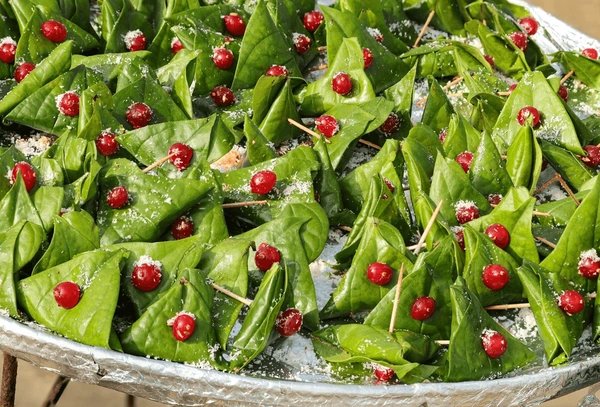
Unlike paan found elsewhere in India, the Banarasi variety uses the prized Magahi betel leaf grown in the Magadh region of Bihar — thicker, fragrant, and less astringent than ordinary betel leaves. The leaf is carefully cleaned, softened and coated with chuna (slaked lime) in precise amounts before the filling is added.
A master paan-wallah in Varanasi may offer 40 to 80 varieties, but the hallmark of a true Banarasi paan is the combination of: rose-petal gulkand (slow-cooked rose jam), saunf (fennel seeds), mukhwas mixture, silver varq, meethi supari (sweetened areca nut), kesar (saffron), cardamom, cloves, and in the sweet meetha variety, a generous dollop of sweet chutney. The paan is folded into a perfect triangle and pinned with a clove, ready to be popped whole into the mouth.
Types of Banarasi Paan – Which One Should You Try?
Meetha Paan (Sweet Paan) — the most popular tourist variety, loaded with gulkand, tutti-frutti, silver varq and kesar. Sweet, fragrant, and completely non-intoxicating. This is what most first-time visitors try.
Sada Paan — a minimalist preparation with just chuna, supari and a few spices. Locals prefer this as an everyday mouth freshener after meals.
Saada Meetha — a balance between sweet and plain, with moderate gulkand and minimal sweeteners.
Fire Paan (Flaming Paan) — a theatrical variant where camphor is burned on the paan as it is placed in the mouth. Completely safe when done by an expert. Makes for a spectacular photo.
Chocolate Paan — a modern innovation that layers Belgian chocolate inside a sweet paan — popular with younger visitors.
Mango Paan, Strawberry Paan, Pan Ice Cream — seasonal and innovative varieties available at premium paan shops near Assi Ghat and Godowlia.
Banarasi Paan's 400-Year Cultural Heritage
Paan culture in Varanasi is documented in Sanskrit texts from the Mughal era. The city's paan-wallahs trace their lineage back generations — families who have prepared paan at the same spot for 100, 150, even 200 years. In the Banarasi tradition, offering paan to a guest is an act of the highest hospitality, equal to offering food or shelter.
During festivals like Dev Diwali, Holi and Diwali, paan consumption in Varanasi spikes dramatically — special seasonal fillings using fresh rose petals, mango pulp, or jaggery are offered only during these periods.
Health Benefits of Banarasi Paan Ingredients
Despite its indulgent reputation, many ingredients in Banarasi paan have Ayurvedic significance: betel leaf has anti-bacterial and digestive properties; fennel seeds reduce bloating; cardamom aids digestion and freshens breath; gulkand (rose preserve) is cooling and good for acidity; silver varq (edible silver) is considered a tonic in Ayurveda.
Note: Traditional Banarasi paan for tourists is always tobacco-free (meetha paan). Avoid any paan containing tobacco (tambaku) or katha (catechu paste) if you are sensitive to stimulants.
Where to Buy the Best Banarasi Paan in Varanasi
The most iconic paan shops in Varanasi are concentrated in two areas:
Bangali Tola (near Maidagin): Home to several 100-year-old paan dukaans. The paan here is considered the most authentic in the city by local connoisseurs.
Godowlia Chowk: The busiest paan hub in Varanasi, with 20+ shops competing side by side. Great for trying multiple varieties and comparing styles.
Assi Ghat Paan Shops: More relaxed setting, popular with the literary and academic crowd from BHU. Excellent evening paan experience with a Ganga view nearby.
Kachori Gali: The food street near Vishwanath temple also has excellent paan shops alongside its famous kachori stalls.
How Much Does Banarasi Paan Cost?
A standard meetha Banarasi paan costs ₹15–30. Premium varieties with dry fruits, saffron, silver varq or exotic fillings range from ₹50–200. A fire paan experience is typically ₹30–50. Compared to any souvenir you can buy in Varanasi, paan is the most affordable authentic cultural experience in the city.
What to Know
Visitor Information
Getting There
How to Reach Banarasi Paan
🍛 Food & Culture · Varanasi
More Food & Culture Experiences
Other top things to do in the same category

Kachori Sabzi at Kachori Gali
The legendary breakfast of Varanasi — crispy kachoris with spiced potato sabzi and jalebi. Kachori Gali near Vishwanath temple has been serving this dish for over 100 years, opening from 6 AM.
View Details
Malaiyyo (Winter Dessert)
A frothy, saffron-and-dew-infused milk dessert available only Oct–Feb — made from morning mist and rose water, churned overnight. Unique to Varanasi and available nowhere else in India.
View Details
Banarasi Saree Shopping
Varanasi is the world capital of silk weaving — the silk bazaars around Vishwanath Gali and Madanpura have handloom Banarasi sarees made by master weavers using centuries-old techniques on traditional pit looms.
View Details
Ganga Fuska & Street Chaat
The Varanasi version of pani puri — smaller, crispier, spicier. The "imli water" (tamarind) variant is unique to Varanasi. Best enjoyed at Assi Ghat and Godowlia crossing stalls after the evening aarti.
View Details🏷️ Handpicked For You
Top Varanasi Tour Packages
Cab · Hotel · Guide all included — curated by VisitKashi
 ⏱ 1 Night 2 Day
1 Night 2 Day Varanasi Package
⏱ 2 Nights / 3 Days
2 Nights 3 Days Varanasi Package
 ⏱ 3 Nights 4 Days
3 Nights 4 Days Varanasi Prayagraj Ayodhya Package
⏱ 4 Nights 5 Days